
Verdict
The most useful starting point depends on what you need to check. UNIQLO is a candidate when you want to compare the fit notes and sizing tools for a specific product. FatFace is worth investigating if its generously cut fit guidance and body measurement chart suit the way you shop. Next's supplied men's guide offers separate charts for trousers and jeans, suits and jackets, and formal shirts. M&S is a place to continue through its size guide categories, though the supplied page excerpt does not show men's measurements.
That makes this a fit-information comparison, not an overall verdict on which retailer makes the best everyday menswear. The supplied evidence does not compare the four brands on fabric, price, durability or buying terms. Use the relevant size guide to narrow your search, then check the exact item's current measurements, fit description, price and terms on the retailer's page before deciding. A shared size label alone may not tell you how a particular garment will fit.
What the Published Evidence Can Tell You
Choosing everyday clothes often involves questions about fit, value and how well an item will work in regular wear. The supplied GQ excerpt provides some general editorial context about value and wearability: it introduces affordable everyday menswear and says it is highlighting pieces intended for frequent wear. The excerpt discusses Carhartt WIP and Everlane, however, so it does not independently rank UNIQLO, Marks & Spencer, Next or FatFace.
For those four retailers, the evidence here is mainly their own sizing information. The pages do not all provide the same kind of detail. One points shoppers toward product-level tools, another describes its cut and provides body measurements, another sets out garment-specific men's charts, and the M&S excerpt is a category-selection page. These are useful clues about where to investigate fit, but they are not comparable product tests.
This guide therefore answers a narrower question: which published sizing information might help you start checking fit for a particular garment? It does not establish how well an item is made, whether it will last, whether it is good value, or which retailer has the most suitable returns or delivery terms. No personal product testing is claimed.
Sizing Strengths in the Supplied Guides
AI-generated generic editorial illustration — not a retailer product photo and does not depict the reviewed product or service. Summarize how the four supplied official excerpts differ in the type and detail of sizing information they show, preserving the distinction between M&S category navigation and the measurement or fit guidance visible elsewhere.
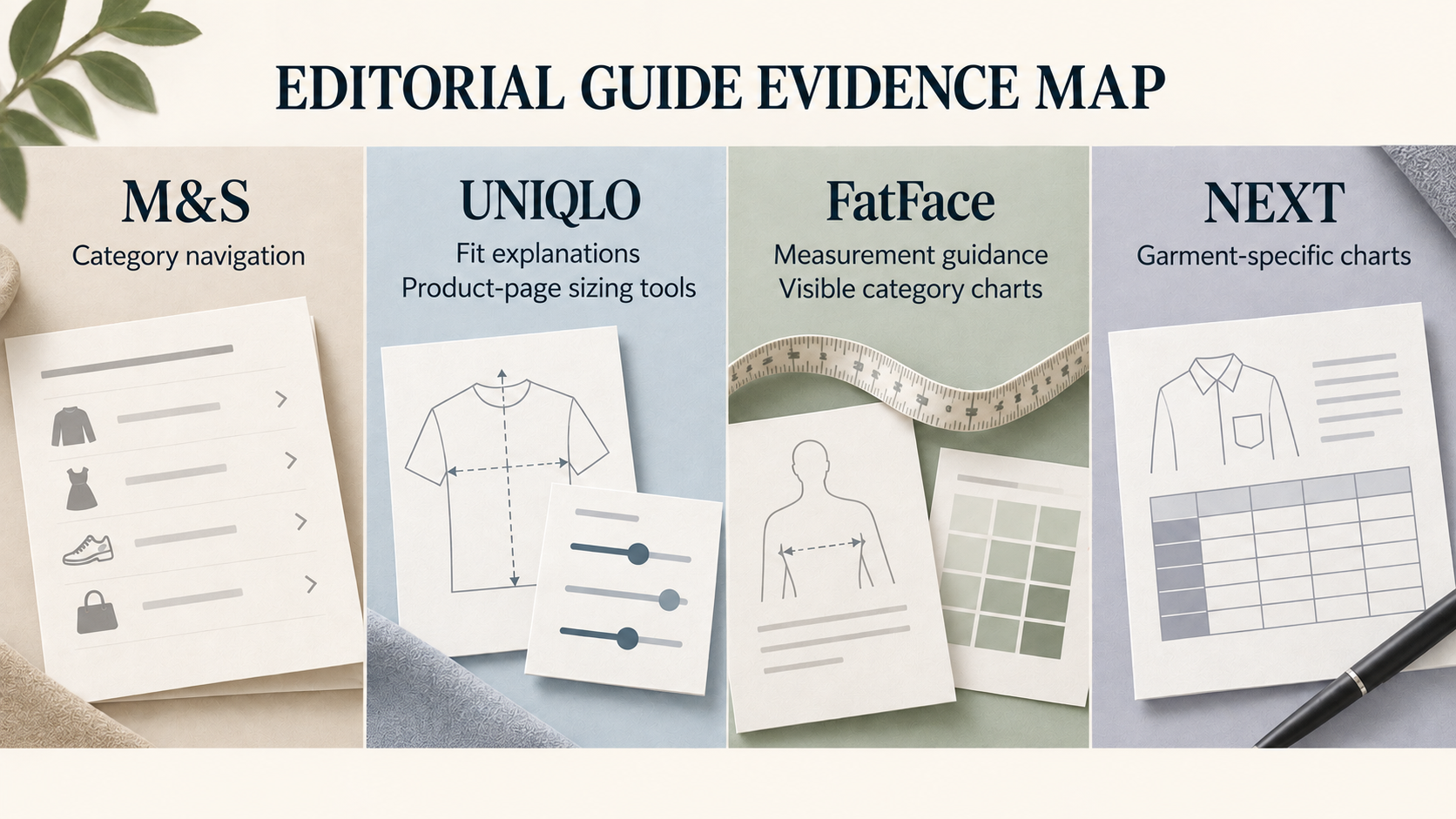
UNIQLO explicitly warns that products with the same size label can fit differently because each item may be designed for a different intended fit, such as regular, slim, relaxed or oversized. Its guide points shoppers to sizing information and tools on individual product pages. Its contents also list measurement information, size charts, product-size comparisons and a fit guide by height. That makes the product page the relevant next step when comparing a specific UNIQLO item, rather than assuming that a size label transfers unchanged across styles. (UNIQLO size guide)
FatFace says its clothes are cut generously for a comfortable fit and advises shoppers to use its sizing guidelines. The supplied excerpt gives instructions for taking measurements and includes a men's clothing chart beginning with chest and waist measurements. It also explains how to measure inside leg, from the crotch seam to the bottom of the hem, and directs readers to product pages for garment lengths. The excerpt gives shoppers both a fit description and measurement information to compare. (FatFace size guide)
Next's supplied men's guide asks shoppers to measure their body and then choose a chart from a dropdown. It shows separate sizing information for trousers and jeans, suits and formal jackets, and formal shirts. Depending on the garment, the listed measures include waist and length, chest and sleeve length, or collar, chest and sleeve length. This garment-by-garment organization can help readers select the chart that matches what they are buying. (Next Men's Sizing Guide)
The supplied M&S page lists size-guide categories, including Men, and prompts visitors to select a category and go to a size guide. The excerpt does not show a men's measurement chart. Treat it as a route into further size information, not as evidence of the measurements available on the linked guide itself. (M&S Size Guides)
What This Comparison Cannot Establish
The supplied retailer excerpts do not substantiate a comparison of fabrics, prices, construction quality or how long garments last across UNIQLO, M&S, Next and FatFace. They describe ways to investigate sizing. They do not evaluate particular everyday essentials from all four retailers under the same conditions, so a fit chart cannot stand in for a product review or a value comparison.
The GQ passage offers context about wanting affordable, wearable everyday clothes, but the supplied excerpt discusses Carhartt WIP and Everlane. It cannot serve as independent evidence that one of these four retailers is better value or more durable than another. Its editorial perspective is relevant to the kinds of questions a shopper may ask, but it does not resolve them for this comparison. (GQ everyday menswear excerpt)
The M&S excerpt also needs a careful reading: it is a category-selection page, not a detailed men's measurement guide in the supplied text. That does not show what a shopper might find after selecting Men; it only means the excerpt itself cannot support a claim about specific M&S men's measurements.
Before buying, use the current item page and retailer terms to check the exact fabric composition, care instructions, price, delivery and returns information, along with the garment's fit notes and measurements. Those details can vary by item and over time. The supplied excerpts do not establish them, so this guide leaves those decisions open for you to verify.
Alternatives by Fit-Information Need
If you are comparing two items at UNIQLO, start with each item's own fit description and sizing tools. The guide says that items sharing a size label can fit differently, which makes product-level information particularly relevant. The supplied evidence does not say which fit will suit you; compare the details for the actual styles you are considering.
If you want a stated cut and body measurements to guide your search, FatFace is a candidate to investigate. Its guide describes its clothes as generously cut and includes a men's chest and waist chart in the supplied excerpt. Use the chart and any relevant product-page length information as checks, rather than assuming the general fit statement predicts how every garment will sit.
If your choice is among different garment types, Next's separate men's charts offer a direct route to the information for trousers or jeans, jackets or suits, and formal shirts. Choose the correct guide before comparing relevant measures. M&S is another place to continue sizing research if its category navigation is useful to you, but the supplied M&S excerpt alone does not give the men's measurements needed to choose a size.
These are starting points based on the type of fit information shown in the supplied excerpts. They are not claims that any one retailer has better clothes or better value. For any of the four, the exact garment and its current product-page information should guide the final check.
Fit-First Shortlist: Where to Start
- UNIQLO: Start with the individual product page if you want to check item-specific fit information and sizing tools; the guide says the same label can fit differently across products.
- FatFace: Investigate its guide if a generously cut fit description and body-measurement chart are useful to you.
- Next: Use the supplied men's guide when you want a chart organized around trousers and jeans, suits and jackets, or formal shirts.
- M&S: Follow the relevant size-guide category if you want to continue from its category index; the supplied excerpt does not show detailed men's measurements.
This is a shortlist of places to begin checking fit information, not a ranking of retailers or products by quality, price or value. Once you have found the relevant guide, compare it with the item you actually intend to buy. If the product page gives details that matter to your decision, use those alongside the general chart and confirm the buying terms directly with the retailer.
Four-Retailer Fit Guide at a Glance
The table summarizes what the supplied excerpts show and the kind of shopper question each source may help you pursue. It is a guide to where to begin checking, not a product-quality or value ranking.
| Retailer | What the supplied guide says | Shopper it may help | What to verify on the product page |
|---|---|---|---|
| UNIQLO | Products with the same size label may fit differently; the guide points to product-page sizing information and tools. | Someone comparing the fit of particular styles. | The chosen item's fit notes, measurements and available sizing tools. |
| FatFace | The clothes are described as generously cut; the excerpt includes measurement instructions and men's chest and waist information. | Someone who wants a cut description and body-measurement guidance. | The item's fit notes and relevant garment lengths or measurements. |
| Next | The men's guide separates trousers and jeans, suits and formal jackets, and formal shirts. | Someone choosing a chart for a specific garment type. | The matching chart and the measurements relevant to that item. |
| M&S | The supplied page lists size-guide categories and directs shoppers to select one. | Someone who wants to navigate from a category index. | The men's guide reached from the category and the exact item's details. |
The level of detail visible here is uneven by design: the M&S excerpt is a category index, while the other supplied excerpts include more direct fit or measurement information. Follow the retailer's guide to the relevant item before making a size decision.
How to Choose and Verify Your Fit
AI-generated generic editorial illustration — not a retailer product photo and does not depict the reviewed product or service. Give readers a visual sequence for applying the supplied guidance: measure, choose the relevant garment guide, compare product-level fit information, and verify current buying details.
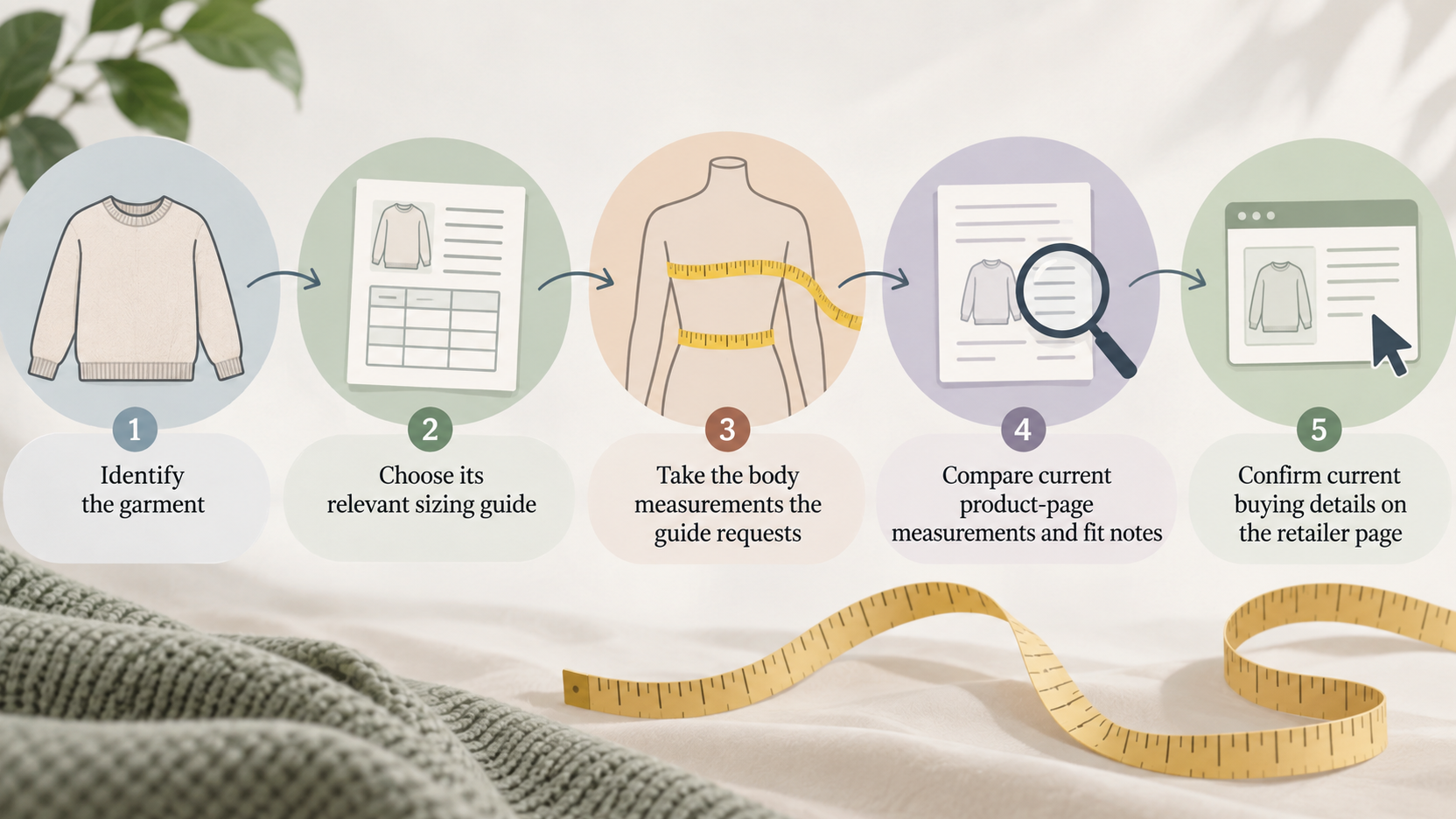
Use this sequence to turn a general size guide into a check for the garment you plan to buy. It keeps the decision tied to the item and to the measurements the relevant retailer actually provides.
- Identify the garment. Decide whether you are checking trousers, a shirt, a jacket or another item. The correct guide may depend on garment type; Next, for example, separates its supplied men's charts by garment category.
- Open the relevant size guide. At UNIQLO, start from the product page because the guide says that the same label can fit differently across items. For Next, select the chart for the garment. At M&S, follow the category navigation to the relevant guide rather than relying on the category index alone.
- Take the measurements the guide requests. Follow that retailer's instructions and compare the same measurement points and units where possible. Next's page explains how to measure the body through its information icons; FatFace's excerpt also gives measurement instructions. Do not substitute a number from a different garment category or assume that a body measurement is itself a garment measurement.
- Compare the product details. Read the fit description and measurements for the exact item. UNIQLO specifically recommends checking product measurements and fit information. FatFace directs shoppers to product pages for lengths. For Next, compare the measures relevant to the chart, such as waist and length for trousers or chest and sleeve length for jackets.
- Confirm buying details on the current retailer page. Check the item's fabric, care information, current price, availability, delivery and returns terms there. These are practical purchase checks, but the supplied excerpts do not compare those terms across the four retailers.
A chart can narrow down what to investigate, but it cannot guarantee how a garment will feel or fit on you. If the fit description or measurements leave a question unanswered, check the retailer's current product information or contact its customer service before ordering. That is especially useful where the excerpt offers a general guide rather than measurements for the exact item.
Frequently Asked Questions
Can the same size label fit differently between UNIQLO products?
Yes. UNIQLO says products can fit differently even when they share a size label, because their intended fits and designs can differ. Its guide recommends checking the sizing information and tools on the individual product page. (UNIQLO size guide)
What measurements should I compare when choosing men's trousers or jeans?
Use the chart for the garment you are considering. The supplied Next guide lists waist and length for trousers and jeans, with length options shown in its chart. Check the relevant chart and the item's current details rather than relying on a size label alone. (Next Men's Sizing Guide)
Does FatFace describe its clothing as a close or generous fit?
FatFace describes its clothes as generously cut for a comfortable fit. Its guide also provides measurement guidance, so compare the relevant measurements and the specific product details when deciding whether an item may suit you. (FatFace size guide)
Do these sources show which of the four retailers offers the best value or return terms?
No. The supplied excerpts do not compare current prices or return terms across the four retailers. Check the current product page and the retailer's terms for those details; the GQ excerpt's general value discussion concerns other brands in the supplied passage. (GQ everyday menswear excerpt)
Related reading
- UNIQLO vs Marks & Spencer: which is the better fit
- UNIQLO review: strengths, limits, and alternatives
- Marks & Spencer review: who it suits and who should skip it
- Next review: practical buying assessment
Editorial information: About our editorial team · Read our editorial policy · Read our affiliate disclosure.