
The value decision in brief
A dependable everyday essential earns its place by solving a real wardrobe problem, working for the way you dress, and being worth the price you would pay today. A low ticket price cannot make an item useful if it duplicates something you already wear, fits poorly, needs more care than you can give it, or only seems appealing because it is promoted.
Before buying, ask four questions: What specific gap will this fill? Can I wear it comfortably with clothes I own? Does its fabric and construction suit my routine? Have I checked the applicable return deadline, condition rules and refund route? If you can answer those clearly and the price fits your budget, buying now may make sense. If one answer is uncertain, wait until you can check it. If the item has no clear role, skip it.
This is a practical decision guide, not a promise that a price will fall later or a claim that one retailer always offers better value. Judge the garment and its terms as they stand. That keeps the choice useful even if no promotion appears.
Start with the wardrobe gap
Begin with your own week, not a retailer’s promotion. Think about the situations you dress for: commuting, working from home, weekends, evenings out or travel. Then look for a repeated point of friction. Perhaps a shirt is uncomfortable under a jumper, your only smart trousers are unsuitable for everyday wear, or a frequently worn layer is no longer comfortable. A concrete problem gives the purchase a job to do.
Check whether something you own already does that job. Look at the items you reach for most often and the pieces that stay unworn. A garment may be missing because you lack it, but it may also be missing because a fit, colour, fabric or care issue makes your current option hard to use. Buying another version without understanding that problem can repeat it.
Try naming the intended use in one sentence: “I need a comfortable layer for the office and travel,” for example. Then name the outfits it needs to work with. If you cannot identify a likely use or a few combinations with existing clothes, pause. A wardrobe gap should be specific enough to guide the choice of garment, colour and features.
Finally, set a limit before browsing. Decide what you can spend without relying on credit or changing another essential plan. This makes it easier to assess the item on its merits instead of treating a discount label as a reason to buy. The aim is not to buy as little as possible; it is to make each addition easier to wear and justify.
Judge fit, fabric and repeat wear
Check fit in the way you expect to wear the item. A shirt that feels fine standing still may pull when you reach forward; trousers can feel different when sitting. If trying it on is possible, move naturally and check the shoulder, waist, rise, sleeve or leg length that matters for that garment. If you are ordering online, use the retailer’s current size information and compare it with a similar item you already own. Sizing labels alone do not tell you how a cut will feel on your body.
Consider fabric in relation to use and care. Ask whether it feels suitable for the season and setting, whether it is comfortable against your skin, and whether its care instructions fit your routine. A piece that needs attention you are unlikely to give may be worn less often, even if it looks good on the hanger. Check the garment label and product details rather than guessing from a fibre name or photograph.
Then test versatility. Can the item work with more than one outfit you already wear? Does its colour sit comfortably beside your usual trousers, knitwear or shoes? A basic need not be plain, but a distinctive detail should earn its place through regular use. For a replacement, compare the new item against the one it would replace and ask whether the change improves comfort, fit or usefulness enough to justify the spend.
There is no universal wear-count that makes a garment good value. Instead, estimate realistically how often it will fit your routine and how long you expect to keep it in rotation. Use that estimate as a check against the price, not as a precise forecast. If the garment works only for an imagined occasion or a future version of your lifestyle, wait until the use is clearer.
Check return terms before you buy
A return policy affects how easy it may be to change your mind, but the details vary by retailer and order. Read the rule for the item and purchase route you are considering. Pay attention to when the clock starts, the deadline, the condition and packaging required, any exclusions, and what form a refund takes. A policy that sounds flexible in general may still have a condition that matters to your order.
For example, UNIQLO UK says store purchases must be returned within 30 days of the purchase date, while online orders must be returned within 30 days of receiving the product. It says the online due date appears in Purchase History. Its stated condition is that items are unused and unwashed, in original condition, with original packaging, tags, labels and accessories intact and undamaged; items must also not fall into its listed ineligible categories. Check the policy details for your item before assuming it qualifies.
NEXT says its 28-day period starts the day after home delivery or, for an order delivered to a store, the day after collection. Returned items must be in perfect condition and original packaging. It says returns within that period receive a full refund to the original payment method; late returns receive an eVoucher instead. That difference may matter if you need money returned to the original payment route rather than store credit.
Treat return terms as part of the purchase decision. Note the due date when the order arrives, keep the packaging if the policy requires it, and check what evidence or process the retailer asks for. If you are unsure whether a product is excluded or how to return it, resolve that question before paying where possible. Do not transfer a deadline or condition from one retailer to another.
Account for return effort and refund routes
The deadline is only one part of the practical calculation. Consider how you would return the item: whether the available route is convenient, whether you need to travel or arrange a postal drop-off, and how the retailer says you can follow progress. A route that is difficult for your schedule can make a return less straightforward, even when it is available.
M&S says customers can make a free return by post and describes its Fashion, Home & Beauty stores as the quickest return option. Its online return steps let customers select a method, then track the returned item and expected refund through an M&S account. The account also shows how many days remain to return an order, so check the order-specific information instead of borrowing another retailer’s deadline.
Include the likely effort in your own value check. If a garment’s fit is uncertain and the only return route you would realistically use is inconvenient, that uncertainty deserves attention before ordering. You might check sizing information, try a comparable cut in store, or wait until you can make a better-informed choice. If a return would be easy to manage and the item otherwise meets your needs, that may reduce the practical friction, but it does not make an unsuitable garment a good purchase.
Refund form matters too. A refund to the original payment method, an eVoucher and an account display of refund progress are different details. Decide which information is relevant to you and read the policy for the retailer and order. Avoid comparing retailers on a single headline such as “free returns”; the deadline, condition, route and refund outcome together shape the experience.
Choose: buy now, wait or skip
AI-generated generic editorial illustration — not a retailer product photo and does not depict the reviewed product or service. Turn the article's wardrobe, garment, price, and return checks into a compact purchase decision flow.
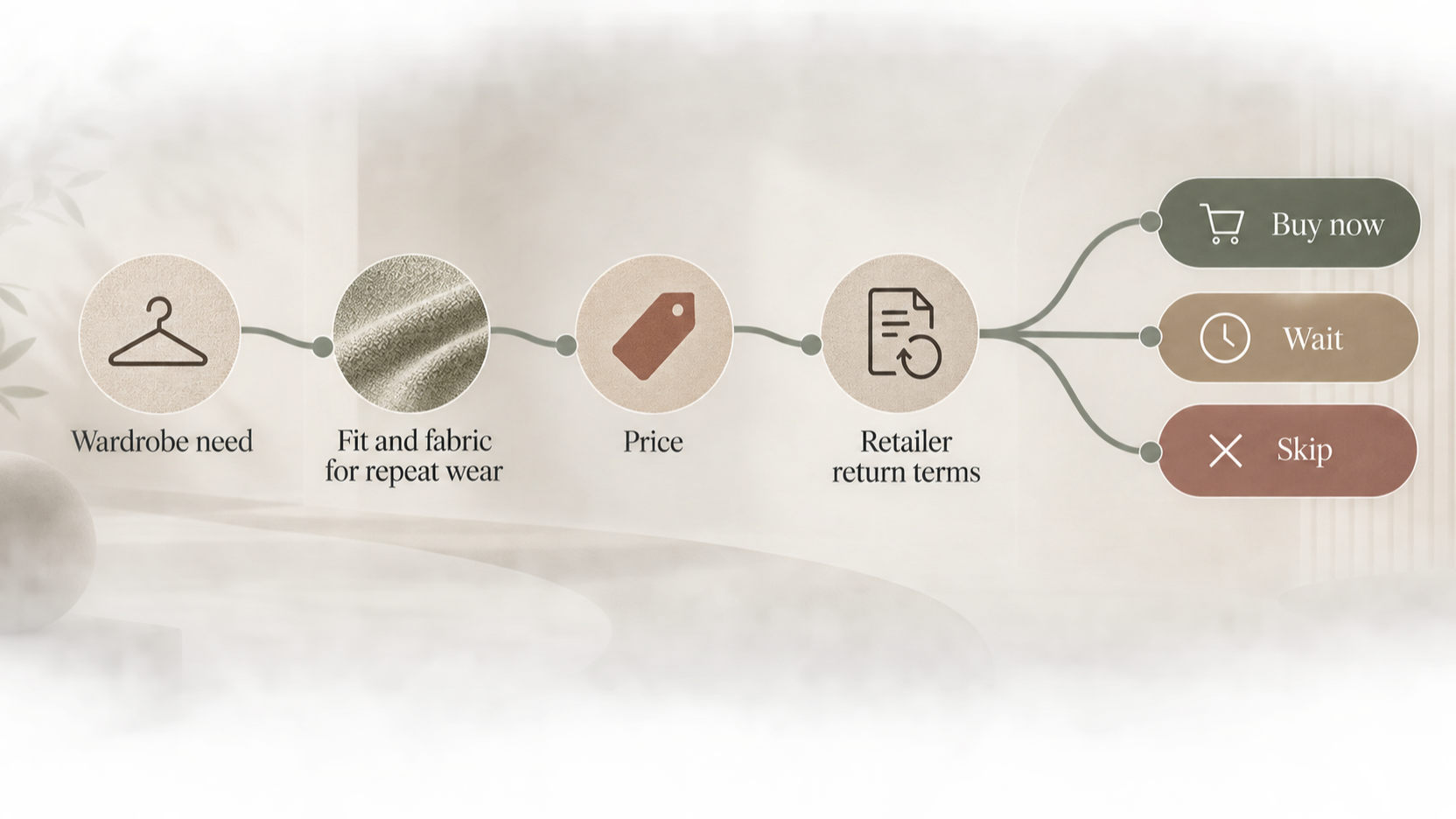
Use this sequence before checking out:
- Name the wardrobe need. Identify a real gap or a specific item that needs replacing. If the need is vague, wait.
- Check the garment. Consider fit, fabric, care, comfort and how it works with clothes you already wear. If a key detail is unknown, find it out before deciding.
- Assess today’s price. Ask whether the item is worth that amount to you now and fits your budget. Do not count on a future sale or treat a promotion as proof of value.
- Review the return terms. Confirm the applicable deadline, start date, condition requirements, return route and refund form. Save or note the relevant order information.
- Make the call. Buy now if the need, suitability, price and terms all make sense. Wait if one answer needs checking. Skip it if the item has no clear job or its drawbacks outweigh its usefulness.
Buy now when you can picture regular use, the fit and fabric suit that use, the current price is acceptable, and you understand what a return would involve. This does not require certainty that the garment will last forever. It means you have checked the points most likely to affect whether you will wear it and whether you can manage a change of mind.
Wait when the decision depends on missing information: you need to check measurements, inspect care instructions, compare the item with something you own, or read the correct returns page. Waiting can also mean setting a budget date or revisiting the need after a few days. It should not depend on assuming that a particular price will appear later.
Skip when the item duplicates a piece that already works, does not suit your intended use, stretches the budget, or only seems worthwhile under an imagined discount. Skipping a weak choice leaves room for a better-fitting option when a genuine need becomes clearer. There is no penalty for leaving a product page without buying.
How the cited retailer policies differ
AI-generated generic editorial illustration — not a retailer product photo and does not depict the reviewed product or service. Compare the supplied official return-policy details while keeping each retailer's terms distinct.
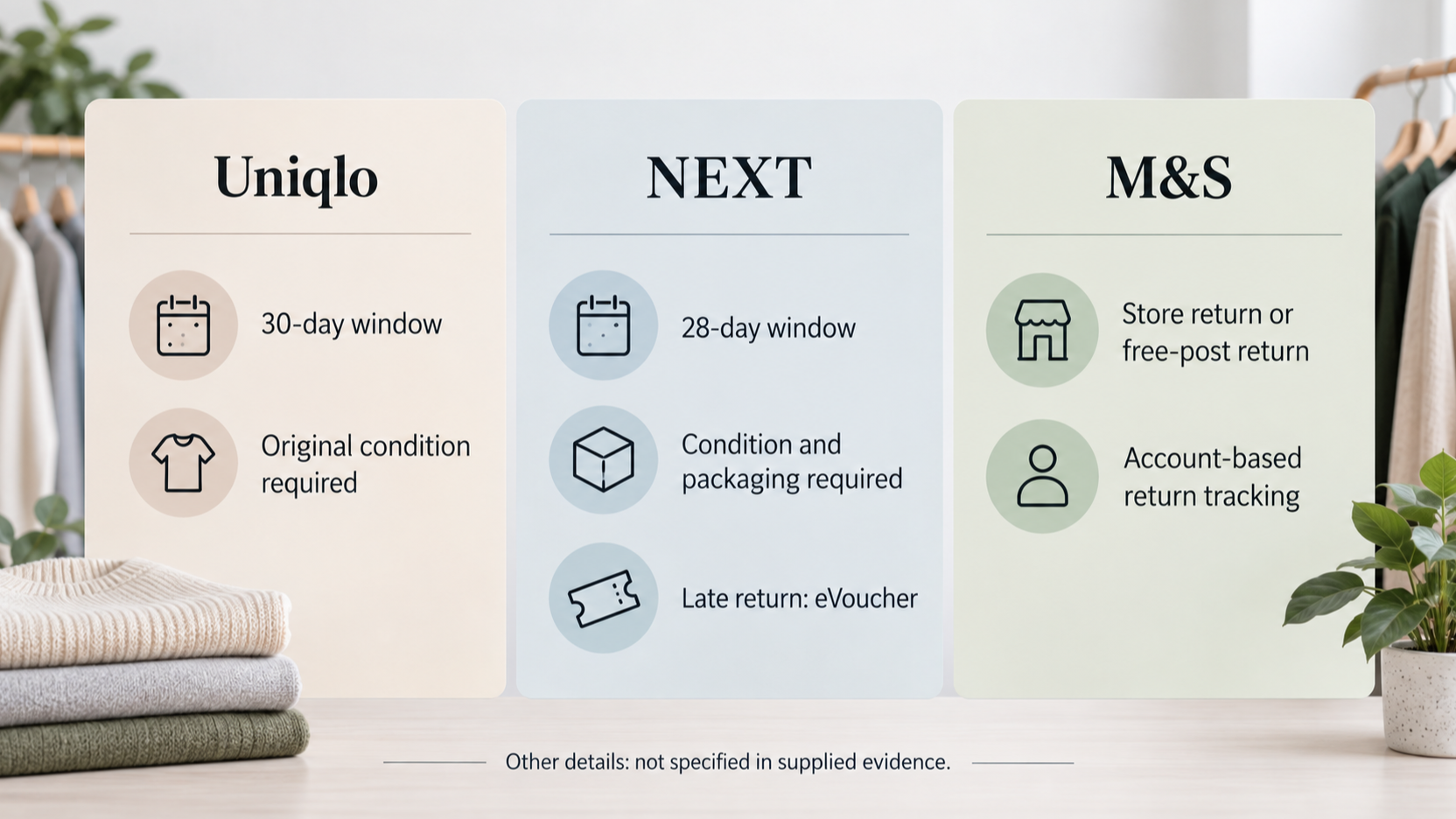
The examples below illustrate why the return policy should be checked for the specific order. They do not establish a universal UK deadline or rank one retailer as the best choice. Product exceptions and order-specific details can matter, so use the retailer’s own current instructions when you buy.
| Retailer | Deadline and timing stated here | Condition or route | Refund or tracking detail |
|---|---|---|---|
| UNIQLO UK | 30 days from purchase for store purchases; 30 days from receipt for online orders. Online due date appears in Purchase History. | Unused, unwashed, original condition; original packaging, tags, labels and accessories intact and undamaged; listed exclusions apply. | The details here do not specify a refund outcome. Check the policy for the order. |
| NEXT | 28 days from the day after home delivery or store collection. | Perfect condition and original packaging. | Within the period: full refund to original payment method. Late return: eVoucher. |
| M&S | Check the order in the M&S account for how many days remain; no fixed number is given in this overview. | Free return by post; M&S identifies its Fashion, Home & Beauty stores as the quickest return option. | Account lets customers track the returned item and expected refund. |
These differences are useful as a checklist. For an online UNIQLO order, check the due date shown against that order. For NEXT, note the day after delivery or collection as the start of its stated period and consider the late-return eVoucher outcome. For M&S, use the account to check the remaining time and choose a return method. Then consider whether those terms suit your circumstances before placing the order.
The comparison does not tell you how a garment fits, whether its fabric suits your routine or whether its price is right for your budget. Those remain separate parts of the value decision. A convenient return option can help with uncertainty, but checking the garment carefully first can save effort and help you choose something you are more likely to wear.
Frequently Asked Questions
How long do I have to return a UNIQLO UK store purchase or online order?
UNIQLO UK states that store purchases can be returned within 30 days of the purchase date. For online orders, it states 30 days from receiving the product, with the due date displayed in Purchase History. The item must meet its return conditions, including the stated original-condition and packaging requirements. Check the policy and your order details for any applicable exclusions.
What refund can I expect if I return a NEXT order within or after its 28-day period?
NEXT says a return within its 28-day period receives a full refund to the original payment method. A return outside that period receives an eVoucher instead. The period starts the day after home delivery or, for an order delivered to a store, the day after collection. NEXT also says items must be in perfect condition and original packaging.
What return options does M&S describe for online orders, and how can I follow a return?
M&S describes free returns by post and identifies its Fashion, Home & Beauty stores as the quickest return option. Customers can start a return through Orders & returns in their account, select a method and follow the returned item and expected refund status there. The account also shows how many days remain for that order, so check it for the applicable timing.
Related reading
- Best UK everyday menswear essentials: evidence-led top choices
- UNIQLO vs Marks & Spencer: which is the better fit
- UNIQLO review: strengths, limits, and alternatives
- Marks & Spencer review: who it suits and who should skip it
Editorial information: About our editorial team · Read our editorial policy · Read our affiliate disclosure.