
Start with the job each item must do
Before you compare products, name the job each one needs to do. An everyday shirt for desk-based work may need to layer neatly; a shirt for travel may need to pack easily; a pair of trousers for frequent wear may need a cut and care routine that suit the places you go. These are prompts, not product claims: begin with your own week, the clothes already in your wardrobe and the situations you want to cover. The aim is to avoid treating a broad label such as “essential” as a universal shopping list.
Turn that use into a short checklist: item type, likely occasions, preferred fit, useful features and a price range you are comfortable with. Separate needs from preferences. A feature is a need if its absence makes the garment unsuitable for a regular situation; it is a preference if it would simply make the item more appealing. This keeps comparisons focused when product pages present many details.
Then compare each candidate in the same order: fit information first, material and care details next, practical value for your routine, and the seller’s current terms. Record what the product page actually says, and leave unknowns blank. If a listing does not give a detail you care about, treat that as an unanswered question rather than filling the gap with a guess. This guide is a repeatable reading method based on published information, not a report of personal product testing.
What official size guidance can tell you
Start with the guide for the category and garment you are considering. The Marks & Spencer size guides list Women, Lingerie, Men, Children, Boys, Girls, Boys School Uniform and Girls School Uniform. That menu is a useful reminder to select the closest matching category; it does not mean every category uses the same measurements or offers the same information.
Retailer guides can also explain how the label relates to the intended cut. UNIQLO says products may fit differently even when they share a size label, because items are designed with different fits, including regular, slim-fit, relaxed-fit and oversized. Its advice is to use sizing information and tools on each product page. Treat the fit description as context for how that particular item is designed, then continue to the measurements and chart for that item.
A garment-specific table can offer more detail than a single letter or number. The NEXT Men’s Sizing Guide asks readers to measure their body and choose a guide from a menu. Its examples include separate tables for trousers and jeans, suits and formal jackets, and formal shirts; the fields differ by garment. Some are labelled “to fit”, while others describe length options. The guide also presents centimetre and inch versions.
Use those resources to make comparisons within the right context: category, item type, fit description, measurement field and units. A chart can help you identify what to check, but it does not make one retailer’s labels a universal conversion system. Keep the item page open alongside any general guide so that the information you use belongs to the garment under consideration.
Build a repeatable fit shortlist
AI-generated generic editorial illustration — not a retailer product photo and does not depict the reviewed product or service. Give readers a repeatable visual sequence for consulting the appropriate garment guide and checking item-level information before choosing a size.
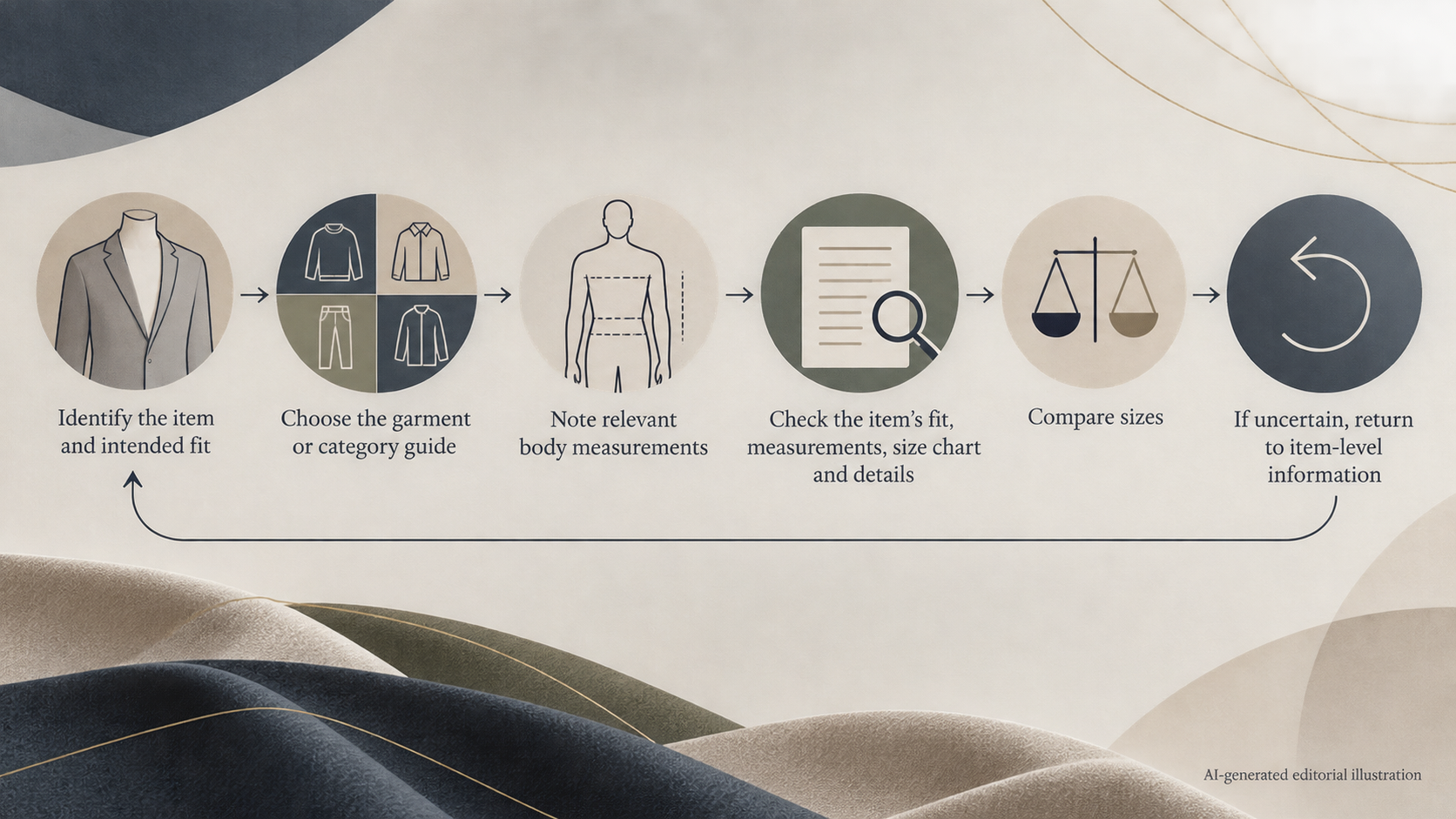
Use the same sequence for each candidate, and keep the notes item-specific. This makes it easier to see where two products differ without assuming that a familiar size label will settle the question.
- Name the garment and intended fit. Note whether you are looking at trousers, a formal jacket, a shirt or another item, and record the product page’s fit description. UNIQLO’s guide explains that its items can share a size label while using different fits, so keep the description attached to the product it describes.
- Choose the matching guide. For the NEXT men’s guide, select the relevant garment table from the drop-down. The guide directs readers to measure their body first, and offers different tables for items such as trousers and jeans, suits and formal jackets, and formal shirts.
- Take only the measurements the guide requests. Follow its instructions for measuring the relevant body area. Record the value and unit beside the field name. The NEXT tables use fields such as trouser waist and jacket chest marked “to fit”; other columns show length options. Match each value to its own row and column rather than comparing unrelated measurements.
- Read the product’s own information. UNIQLO recommends checking the product details, size chart and product measurements, and provides options such as comparing product sizes and a height-based length guide. Treat these as item-level information to review alongside the general fit description.
- Keep the shortlist open if details do not align. If the chart, fit description or product measurements leave a question unanswered, return to that product’s information or the retailer’s sizing help. Keep both plausible options in your notes until the available details resolve the question; do not turn a partial match into a guaranteed size recommendation.
A simple note can include the item name, fit description, guide used, relevant body measurement, chart field and units, product measurement, and any remaining question. This is not a formula for choosing a size. It is a way to compare like with like and see which parts of the decision are supported by the published information.
Where size labels and charts leave uncertainty
Treat a size label as one piece of information, not as a promise that two garments will fit alike. UNIQLO explicitly says products with the same label may fit differently depending on design and intended fit, with examples such as regular, slim-fit, relaxed-fit and oversized. That is a retailer-specific statement about its products; it does not establish a universal pattern or a conversion between every UK brand’s labels.
A chart can narrow the questions to investigate, but the field names matter. A body measurement and a garment measurement are not interchangeable simply because both use centimetres or inches. The NEXT guide asks readers to measure their body and uses “to fit” labels for some chart fields. UNIQLO separately directs shoppers to item-level product measurements and size charts. Keep the guide’s stated measurement type beside each number instead of copying values into a single undifferentiated list.
The supplied examples show that official guidance can vary by retailer and garment category. They do not establish sizing consistency across UK retailers, nor do they show that a measurement from one retailer maps directly to another’s size label. When a brand label feels familiar but the product information raises a question, check that item’s fit description, chart and measurements. If the relevant details are not published or remain unclear, record the uncertainty and seek clarification from the retailer rather than assuming the label settles it.
Compare fabric and practical value for your routine
Once a garment makes the fit shortlist, assess its published material and care information against how you expect to use it. This is a comparison of what the product page states, not a claim about how a fabric will feel or perform in use. Avoid assigning qualities to a material unless the retailer actually describes them.
For each candidate, note the details that are available:
- Fibre composition and any material percentages, copied as shown.
- Care instructions and any specific limits or steps stated by the seller.
- Construction, lining, pockets, closure or other features that matter to your use, if the listing describes them.
- The displayed price and any delivery or other charges presented before purchase.
- The occasions you expect the item to cover and how often you expect to wear it.
Then compare the notes against your original checklist. A lower displayed price may matter to your budget, while a garment that covers more of your regular situations may matter more to your wardrobe plan. Those are personal trade-offs, not a universal ranking. If a care detail is missing, do not assume that the item can be treated like another garment you own; keep it as an open question. If two descriptions use different wording, quote each one accurately rather than treating them as equivalent.
This method helps keep “value” tied to your own routine. It does not establish durability, comfort or cost per wear from a product description alone. Choose only when the published details answer the needs you set, and be comfortable leaving a candidate out when key information is unavailable.
Check retailer terms before you buy
Make the retailer’s current terms part of the comparison, and check the information that applies to the way you plan to buy. Policies can be specific to the seller and purchase route, so do not rely on a remembered policy or assume that another retailer’s conditions apply. The supplied UNIQLO customer-service page, for example, separates return and exchange information for online and store purchases; it does not provide a general policy for all UK retailers.
Before placing an order, open the relevant terms and confirm the details that affect your decision. Note the return or exchange window as stated, any conditions on the item, the available return route, and whether the policy page is for an online or store purchase. Check how the seller says to start a return and whether there are fees or other stated steps. These are points to verify in the retailer’s own current wording, not assumptions about what the wording will say.
If an item’s fit remains uncertain, consider whether the terms give you an acceptable option if it does not suit you. Read the details for the exact seller and purchase route, and save or bookmark the information with your product notes. If a policy is unclear, ask the retailer before ordering. Do not treat a size guide as a substitute for understanding the terms attached to a purchase.
Frequently Asked Questions
Are men’s size labels consistent across brands and garment types?
The supplied sources do not establish a cross-brand conversion or prove that labels are consistent across UK retailers. UNIQLO says that even its own products with the same size label may fit differently according to the item’s design and intended fit. The NEXT men’s guide also separates its tables by garment type. Check the specific item’s fit description and sizing information instead of transferring a label from one product to another.
How should I choose a size when the product fit description and size chart both matter?
Read them together as different parts of the item’s information. Note what fit the product page describes, then use the matching garment guide and its stated measurement fields. UNIQLO recommends checking the product details, product measurements and size chart on each product page; NEXT directs readers to measure their body and select a garment-specific guide. If those details do not answer your question, consult the retailer’s sizing help rather than guessing.
What should I check in a UK retailer’s returns policy before ordering clothes?
Check the current terms for the seller and purchase route you intend to use. Confirm the conditions, timing, return method and any other steps or costs as the retailer states them. The supplied UNIQLO service page lists separate return and exchange information for online and store purchases, but the evidence here does not specify the terms of other retailers. Read the applicable policy directly before ordering.
How can I compare fabric and care information for everyday menswear?
Copy the composition and care details exactly as each product page presents them, then compare those statements with your routine and preferences. Do not infer comfort, durability or care requirements that the retailer has not stated. The supplied sizing sources do not provide fabric or care details for specific garments, so use the relevant product page for that information and keep unanswered points as questions.
Sources
Related reading
- Best UK everyday menswear essentials: evidence-led top choices
- UNIQLO vs Marks & Spencer: which is the better fit
- UNIQLO review: strengths, limits, and alternatives
- Marks & Spencer review: who it suits and who should skip it
Editorial information: About our editorial team · Read our editorial policy · Read our affiliate disclosure.